Cited CRM pages: ChatGPT restated a price, cap or verdict in 10 of 11
 By Tom Benattar · · 4 min read
In 10 of 11 ChatGPT CRM answer passages checked, the cited page held the line used: a price per seat, a user cap or a one-sentence vendor verdict.
In 12 ChatGPT answers to six CRM buying questions, 11 answer passages could be set against the 6 cited pages we were able to read, and in 10 of the 11 the page held a line the passage rests on: a price per seat, a free plan cap, or a one-sentence verdict on a vendor. I ran the study with Cited.today, on HubSpot's category, on 14 November 2026.
A line found on the cited page shows what the answer rests on, not that ChatGPT took it from that page: the same figure may appear elsewhere.
A free plan cap, stated in one sentence
Question “best free CRM”
ChatGPT answered, 14 Nov 2026
“1. HubSpot CRM (Best overall) - Contact and customer management - Sales pipeline and deal tracking - Email tracking and meeting scheduling - Marketing and customer service tools Free plan: Up to 2 users and 1,000 contacts. Visit HubSpot ---”
It cites Free CRM Software for Small Businesses | HubSpot (opens in a new tab), HubSpot's own page
“With up to two users, 1,000 contacts, and no limits on customer data, HubSpot’s free CRM functionality is 100% free, with no expiration date.”
The page's own words, read on 14 Nov 2026.
HubSpot's CRM product page (opens in a new tab) puts its whole free offer in one sentence: up to two users, 1,000 contacts, no expiration date. The answer keeps the two numbers as written, so a cap stated as a plain sentence is a cap an answer can repeat.
A price per seat, without its condition
Question “best CRM for small business”
ChatGPT answered, 14 Nov 2026
“1. HubSpot CRM (Best overall) - Free plan available. - Contact management, sales pipelines, email tracking, marketing tools. - Easy to learn and implement. - Paid plans start around $15/seat/month in some configurations. Website: HubSpot CRM ---”
It cites Free CRM Software for Small Businesses | HubSpot (opens in a new tab), HubSpot's own page
“Starter Starts at $15/month per seat*”
The page's own words, read on 14 Nov 2026.
The same page lists "Starts at $15/month per seat*" for Starter, and its footnote says the discount is for new customers only and can be discontinued at any time. The answer hedges with "in some configurations" but does not carry the condition; our reading: if a price depends on a condition, write the condition in the same sentence as the price.
A verdict on two rivals, on a question HubSpot was not named in
Question “Salesforce vs Zoho CRM for a 20-person sales team”
ChatGPT answered, 14 Nov 2026
“Salesforce's main advantage is its extensive customization and integration ecosystem. Zoho's advantage is delivering a broad range of CRM capabilities at a lower price point. 2. Pricing for 20 salespeople Here are the published Salesforce prices available for comparison, using USD and assuming all 20 users need licenses.”
It cites Salesforce vs. Zoho: Which CRM is better for cross-team alignment? (opens in a new tab), HubSpot's own page
“Salesforce is known for its robust customization and deep ecosystem, making it a top choice for large organizations. Zoho stands out for its affordability, bundled apps, and quick setup”
The page's own words, read on 14 Nov 2026.
On the head-to-head question between Salesforce and Zoho CRM, HubSpot's own pages are cited in 2 of 2 answers, through its blog article Salesforce vs. Zoho (opens in a new tab), while HubSpot is named in 0 of 2. Both answers restate the article's verdicts: one rests on "robust customization and deep ecosystem" against "affordability, bundled apps, and quick setup", the other on "Salesforce leads in power and ecosystem, while Zoho excels in simplicity and speed."
The article holds a table comparing Salesforce, Zoho CRM and HubSpot, a best-fit verdict per team type, a five-step decision framework, and a stated update date of 09/14/26. Our reading: a publisher can be the cited source on a head-to-head question it is not the subject of, though here that rests on 2 answers.
A competitor's pricing page, cited for one number
Question “cheaper alternatives to Salesforce for a small B2B startup”
ChatGPT answered, 14 Nov 2026
“5. Bigin — best ultra-low-cost option - Simple pipelines. - Contact and company management. - Easy to get started. - Particularly attractive for founder-led sales. Watch out: Less sophisticated for complex B2B sales processes and larger teams. Pricing: Express approximately $7/user/month, billed annually. Bigin pricing 3. What could you save? Illustrative annual subscription costs for a five-perso”
It cites Bigin Pricing and Editions | The Most Affordable CRM (opens in a new tab), Bigin by Zoho's own page
“US$ 7 /user/month/billed yearly”
The page's own words, read on 14 Nov 2026.
Bigin's pricing page (opens in a new tab) states "US$ 7 /user/month/billed yearly", and the answer gives Express at "approximately $7/user/month, billed annually". On the same question, the Attio passage matched its cited pricing page (opens in a new tab) only through the page's closest sentence, shared words only.
Where the cited page had no price
The one passage with no restating line on its cited page gives Freshsales "paid plans from around $9/user/month" and cites the Freshsales page (opens in a new tab), on which no prices appear; it states a 21-day trial. Our reading: where the cited page lacks a price, the answer's price has no line on it to rest on.
What the cited pages state
| Cited page | Line an answer rests on | What else the page states |
|---|---|---|
| HubSpot CRM (opens in a new tab) | "up to two users, 1,000 contacts"; "Starts at $15/month per seat" | Professional from $50/month per seat; new-customer discount footnote; updated 2025-09-24 |
| HubSpot Sales Hub (opens in a new tab) | "Free, No credit card required, $0/month" | Enterprise from $150/month per seat; custom objects in the enterprise edition only |
| HubSpot: Salesforce vs. Zoho (opens in a new tab) | one-sentence verdict per vendor | three-vendor table, verdict per team type, five-step framework, updated 09/14/26 |
| Bigin pricing (opens in a new tab) | "US$ 7 /user/month/billed yearly" | free edition for one user with 500 records; yearly billing saves up to 35% |
| Attio pricing (opens in a new tab) | closest sentence only, the Pro plan description | free for up to three users; 80% off the annual Pro plan in year one for venture-backed startups; a team type per plan |
| Freshsales (opens in a new tab) | "intent scores from Freddy AI"; preferred channels | no prices; a 21-day trial |
Pricing and comparison pages in the citation mix
Brands' own sites take 72 of 122 citations in the answers we collected; among those 72, homepages take 29, pricing pages 10 and comparison pages 7.
The brands' own pages ChatGPT cites, by kind
Citations of brands' own pages, by what the page is (an answer citing a page counts once)
- Homepages29 (29 of 72)
- Other pages19 (19 of 72)
- Pricing pages10 (10 of 72)
- Comparison pages7 (7 of 72)
- Product pages5 (5 of 72)
- Help and docs2 (2 of 72)
HubSpot's own pages are cited in 12 of 12 answers, on all six questions. Two of its cited pricing pages could not be read, so what the passages citing them rest on is unknown.
How the pages were found
Cited.today asked the six questions twice each through its ChatGPT collection, with web search on, and counted the brands each answer names and the pages it cites. It then read the cited pages it could open and set each answer passage against the page it cites.
What to publish on your pricing and comparison pages
For founders and content leads in a crowded software category:
- One sentence per plan with the price per seat and the billing period. Bigin's "$7 /user/month/billed yearly" and HubSpot's "$15/month per seat" both turn up in answers. Keep any condition, such as a new-customer discount, in that same sentence.
- The caps of your free or entry plan, in plain words. Users, contacts or records, written as HubSpot writes "up to two users, 1,000 contacts".
- Who each plan or option fits. A line per team type, like the verdicts both Salesforce vs Zoho answers rest on.
- A dated comparison of two competitors. A table, a verdict per team type, decision steps and a visible update date, as in HubSpot's cited article. It can bring your site into questions where your brand is not the subject.
- The price on the page you want cited for it. The Freshsales passage gave a price its cited page does not hold.
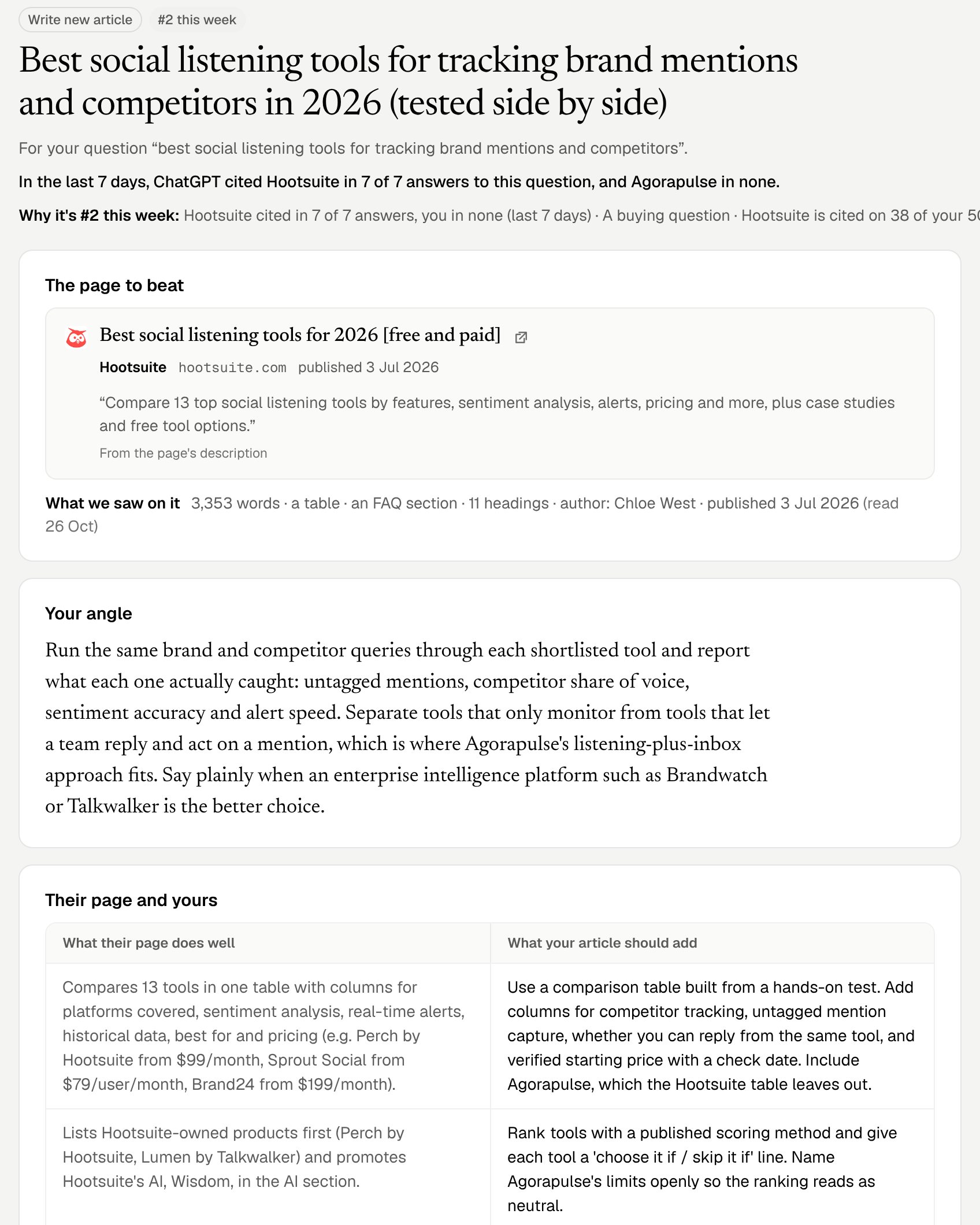
To know which competitor pages to answer first, Cited.today finds the pages ChatGPT cites on your buyers' questions where you are not cited, reads them, and each week proposes up to 10 articles to write, each with a brief. For the brand side of the same category, see Best CRM answers in ChatGPT restate caps, prices and verdicts (opens in a new tab).