ChatGPT software picks rest on a cited page line in 15 of 15
 By Tom Benattar · · 6 min read
In 15 ChatGPT passages on marketing tools, each cited page held a line the answer used: a price with its contact limit, a best-for verdict or feature list.
In 12 ChatGPT answers to six marketing software questions, I set 15 answer passages against the 8 pages they cite, and in all 15 the cited page holds a line the passage rests on: a price with its contact count, a best-for verdict or a one-line feature summary. I ran the study with Cited.today, which asked the questions on 29 November 2026. In 11 of the 15, the line is quoted from the page; in the other 4, it is the page's sentence sharing the most words with the passage, so it is a line the answer rests on, not proof the answer copied it.
HubSpot's own pages were cited in all 12 answers, on all six questions. For a content team, the more useful finding is elsewhere: ActiveCampaign's entry price reached two answers through its own blog comparison guides.
Vendor pages carry most of these answers
Brands' own sites take 82 of the 134 citations in this sample; media and blogs take 42, review sites 7 and other homepages 3. Our reading: on these questions, what a vendor publishes on its own site is what the answers lean on most.
Brands cited with their own pages
Share of the answers that cite a page of each brand's own site
- HubSpot100% (12 of 12)
- ActiveCampaign83% (10 of 12)
- Brevo83% (10 of 12)
- Klaviyo67% (8 of 12)
- Mailchimp50% (6 of 12)
- Adobe Marketo Engage42% (5 of 12)
HubSpot is cited with its own pages in 12 of 12 answers, ActiveCampaign and Brevo in 10 of 12, Klaviyo in 8 of 12. Being named is a separate count: ActiveCampaign and Brevo are each named in the text of 10 of 12 answers, HubSpot Marketing Hub in 8 of 12.
Homepages dominate the citations of brands' own pages, and blog guides are rare among them:
| Kind of own page | Citations (of 82) |
|---|---|
| Homepages | 47 |
| Pricing pages | 13 |
| Product pages | 13 |
| Other pages | 7 |
| Guides and articles | 2 |
Those 2 guide citations are the ActiveCampaign articles below, and both carry a price an answer repeats.
Four passages and the line each rests on
Question “best email marketing software for businesses”
ChatGPT answered, 29 Nov 2026
“2. ActiveCampaign (Best for automation) - Advanced automated email sequences - CRM and sales automation - Lead nurturing and customer journeys - Behavioral targeting Starts around $15/month for 1,000 contacts with annual billing. Official website · ---”
It cites 8 Best Email Marketing Software: A Head-to-Head Comparison | ActiveCampaign (opens in a new tab), ActiveCampaign's own page
“ActiveCampaign plans start at $15 per month for 1,000 contacts on Starter with annual billing, or $19 per month billed monthly.”
The page's own words, read on 29 Nov 2026.
ActiveCampaign's comparison guide states its own entry price as one self-contained sentence: amount, plan, contact limit, billing basis and the monthly alternative. The answer keeps the amount, the contact limit and the billing basis. The guide is dated 10 November 2026 and says "Prices are current as of November 2026." A second answer gives the same "$15/mo Starting price, annual billing, 1,000 contacts" while citing ActiveCampaign's Mailchimp alternatives article (opens in a new tab), whose comparison row reads "$15/mo (1,000 contacts)".
Question “best marketing automation software in 2026”
ChatGPT answered, 29 Nov 2026
“1. HubSpot Marketing Hub (Best overall) - Best for: B2B, inbound marketing, growing businesses. - Features: CRM, email automation, landing pages, lead scoring, analytics and workflows. - Pricing: Free tools; paid tiers vary, with Professional around $800–$890/month. - Strength: Excellent integration between marketing and sales. - Weakness: Can become expensive as you scale. Official website ---”
It cites Marketing Software that Grows and Converts Demand | HubSpot (opens in a new tab), HubSpot's own page
“You can get started for free with Marketing Hub's free tools”
The page's own words, read on 29 Nov 2026.
HubSpot's product page (opens in a new tab) gives its free entry point in one line, and the answer's pricing bullet opens with "Free tools". The Professional price range in the same answer matches a line on a rival's page: ActiveCampaign's comparison guide (opens in a new tab) writes that Professional "starts at about $800 per month billed annually, or $890 monthly, with three seats and a required $3,000 one-time onboarding fee." Our reading: a brand's price facts circulate on competitors' pages too, so the clearest version should sit on your own.
Question “HubSpot Marketing Hub vs Marketo for a mid-sized B2B company”
ChatGPT answered, 29 Nov 2026
“Professional includes 3 Core Seats and 2,000 marketing contacts. Enterprise includes 5 Core Seats and 10,000 marketing contacts. Required one-time onboarding is $3,000 and $7,000, respectively. Prices and promotional offers may vary. Source: ---”
It cites HubSpot Products & Services Catalog | Product Features (opens in a new tab), HubSpot's own page
“$3,000 one-time required onboarding”
The page's sentence closest to the answer, read on 29 Nov 2026.
On the HubSpot vs Marketo question, the answers giving seats, contacts and onboarding fees cite HubSpot's legal product catalog (opens in a new tab), not a marketing page. The match is the catalog's closest sentence, "$3,000 one-time required onboarding", and both catalog pages state recent updates, on 2 November and 5 November 2026. What to take from it: the terms buyers weigh in a head-to-head (seats, included contacts, required fees) need a page that states them plainly.
Question “cheaper alternatives to Salesforce Marketing Cloud for small businesses”
ChatGPT answered, 29 Nov 2026
“2. ActiveCampaign (Best for sophisticated automation) $15/mo Starting price, annual billing, 1,000 contacts - Advanced customer journey automation - Behavioral triggers - Dynamic segmentation - Lead scoring - CRM and sales automation Best for: Businesses that need Salesforce-like marketing automation without Salesforce complexity. ActiveCampaign pricing · ---”
It cites 14 Best Email Marketing Services in 2026 Compared (opens in a new tab)
“Best for advanced automation: ActiveCampaign”
The page's own words, read on 29 Nov 2026.
The iTechGuides comparison (opens in a new tab), cited in 3 of 12 answers, opens with "There is no single best email marketing service in 2026" and then gives one verdict per use case. It states that prices were checked against official provider pages on August 10, 2026, and answers restate both its verdicts and its prices, such as MailerLite's plan from $12 a month. It is a third party with an affiliate disclosure, counted here for context: it shows the verdict format an answer lifts, which a vendor can also write about itself.
Two of the 15 matches are weak: passages about Zoho Marketing Plus and EngageBay cite an EmailToolTester guide (opens in a new tab) whose closest sentence is about HubSpot.
The eight pages read, side by side
| Page | Cited in | Line the passage rests on | Date the page states |
|---|---|---|---|
| HubSpot product page | 4 of 12 answers | "You can get started for free with Marketing Hub's free tools" | updated 2025-08-27 |
| HubSpot homepage | 4 of 12 answers | "Run campaigns, personalize content, and track it all." | none found |
| HubSpot catalog, pricing overview | 1 of 12 answers | closest sentence, on Core Seat pricing | updated 2026-11-02 |
| HubSpot catalog, product features | 1 of 12 answers | "$3,000 one-time required onboarding" | updated 2026-11-05 |
| ActiveCampaign, Mailchimp alternatives | 1 of 12 answers | "$15/mo (1,000 contacts)" | 2026-11-23 |
| ActiveCampaign, comparison guide | 1 of 12 answers | "$15 per month for 1,000 contacts on Starter with annual billing" | 2026-11-10 |
| iTechGuides comparison | 3 of 12 answers | "Best for advanced automation: ActiveCampaign" | updated 2026-10-29 |
| EmailToolTester guide | 2 of 12 answers | closest sentence, about HubSpot | 2026-07-22 |
HubSpot's marketing pricing page (opens in a new tab), cited in 4 of 12 answers, could not be read, so what it holds is unknown.
The two ActiveCampaign guides are each cited in 1 of 12 answers, but both are dated, one lists its criteria ("automation, pricing (as your list grows), deliverability, G2 and Capterra reviews and help moving off Mailchimp"), and one discloses "ActiveCampaign is our product" and names where it falls short: "Brands that manage millions of contacts through data warehouses and a CDP tend to outgrow ActiveCampaign." Our reading: a vendor guide written this way reads like a comparison an answer can use, not a sales page; the data does not show these traits caused the citation.
The HubSpot passages rest on short positioning lines instead: "Everything You Need to Build and Convert Demand, All in One Place" on the product page, "Run campaigns, personalize content, and track it all." on the homepage. Answers turn those into feature bullets. For a closer look at that pattern, see how short homepage feature lines feed best software answers (opens in a new tab).
How the pages were found
Cited.today asked the six questions through its ChatGPT collection, with web search on, twice each, counted the brands each answer names and the pages it cites, then read the cited pages it could fetch and set each answer passage against the page it cites. Cited.today is a GEO (generative engine optimization) tool for SaaS teams: every day it asks ChatGPT the questions your buyers ask, shows which competitor pages ChatGPT cites instead of your site, and tells you which article to write.
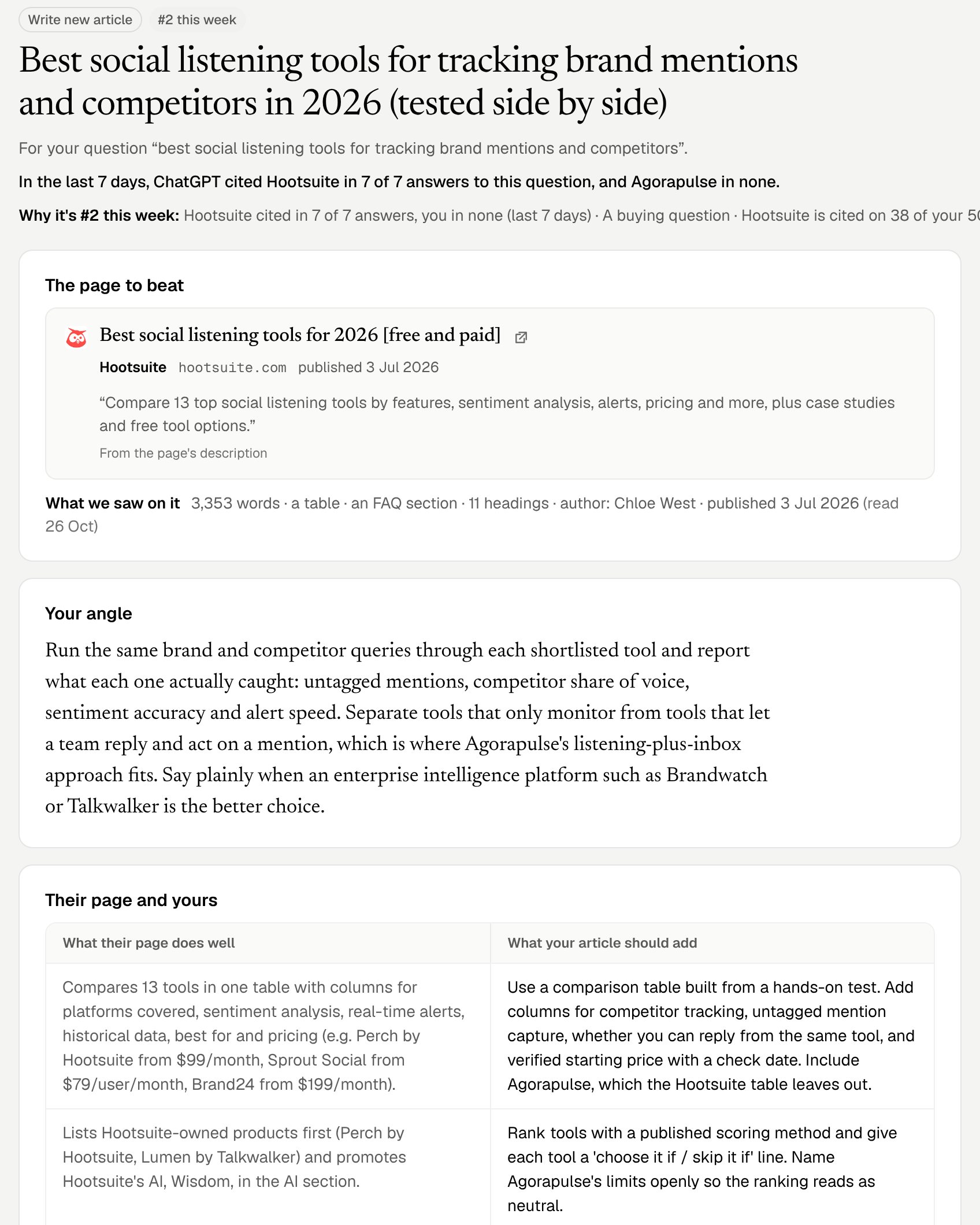
A brief like this one names the competitor page cited on one question, how often in the last 7 days, and what your article should add against it.
What to publish on your own site
For content and product marketing leads in a crowded software category, these are the pages to create or fix, each tied to a line seen in this data:
- A starting price stated as one sentence. Amount, plan name, billing basis, contact or seat limit, and the monthly alternative, with the month it was checked. ActiveCampaign's guide line was restated almost word for word in an answer.
- A one-sentence best-for statement. "Best for advanced automation: ActiveCampaign" on a third-party page and "HubSpot: best for B2B teams that need tight sales and marketing alignment" on ActiveCampaign's page are the format answers reuse as headers.
- A feature summary in plain lines on your homepage and product page. HubSpot's cited passages turn its short positioning lines into bullets.
- A plain terms page for seats, included contacts and required fees. On the head-to-head question, the answers cite HubSpot's catalog for exactly those terms.
- A dated comparison guide on your blog. List your criteria, date your prices, disclose that you are reviewing your own product and say where it falls short, as both ActiveCampaign guides do. See also how Asana's comparison guides get cited on rivals' questions (opens in a new tab).
Cited.today finds the competitor pages cited on your buyers' questions, reads them for the prices, verdicts and dates they carry, and proposes the articles to write.