GEO tool answers in ChatGPT restate prices, features and verdicts
 By Tom Benattar · · 5 min read
In 15 ChatGPT passages on the best GEO tool for a SaaS, 14 rest on a line the cited page holds: a starting price, a feature list or a one-line verdict.
In 12 ChatGPT answers to three questions about the best GEO tool for a SaaS, 14 of the 15 answer passages we set against the page they cite rest on a line that page holds: a starting price, a plain feature list or a one-line verdict. I ran the study with Cited.today on 15 November 2026, and we read 8 of the 46 pages the answers cite, so that figure covers those passages only.
This is Cited.today's own category, so one plain fact first: Cited.today is not among the brands these answers name, nor among the sites they cite. Otterly.AI and Scrunch AI are named in 12 of 12 answers, Peec AI in 11 of 12 and Semrush in 9 of 12.
Brands ChatGPT names
Share of the answers that name each brand
- Otterly.AI100% (12 of 12)
- Scrunch AI100% (12 of 12)
- Peec AI92% (11 of 12)
- Semrush75% (9 of 12)
- AthenaHQ25% (3 of 12)
- Promptwatch17% (2 of 12)
A starting price in one sentence: Semrush's own roundup
Question “What is the best GEO tool to get my SaaS cited by ChatGPT?”
ChatGPT answered, 15 Nov 2026
“5. Semrush - Traditional SEO plus AI visibility. - Competitor and prompt research. - AI-readiness site audits. - AI Visibility Toolkit around $99/month. Website: Semrush Pricing is indicative, based on November 2026 comparisons. Plans and included prompt/model limits vary. Sources: 2. What I'd actually measure for your SaaS Don't just measure whether ChatGPT mentions your brand. I'd track five thi”
It cites The 9 Best Generative Engine Optimization (GEO) Tools of 2026 (opens in a new tab), Semrush's own page
“Semrush’s AI Visibility Toolkit starts at $99/month.”
The page's own words, read on 15 Nov 2026.
Semrush's blog article The 9 Best Generative Engine Optimization (GEO) Tools of 2026 (opens in a new tab) holds the sentence "Semrush's AI Visibility Toolkit starts at $99/month.", and three passages, one for each question, give Semrush that same price. The article is cited in 11 of 12 answers; it is signed by Margarita Loktionova and states it was published 2025-07-28 and updated 2026-07-20. Our reading: a comparison of the whole category, published on the brand's own blog and putting the brand in the list with its price, serves as a source for answers about the category. What to take from it: write your starting price as one sentence, on a page that compares the field.
What the product does, in one sentence: Peec AI's instructions page
Question “Which generative engine optimization tool works best for getting my SaaS mentioned by ChatGPT?”
ChatGPT answered, 15 Nov 2026
“1. Peec AI (Best overall for mid-market SaaS) - Tracks ChatGPT mentions, rankings, sentiment and citations. - Shows which sources AI engines cite. - Benchmarks you against competitors. - Tracks ChatGPT alongside Gemini, Perplexity and others. Particularly useful for finding prompts where competitors appear but you don't. Website: Peec AI ---”
It cites AI Instructions for Peec AI (opens in a new tab), Peec AI's own page
“**Note that Peec AI tracks Visibility, Position, and Sentiment** across AI engines, benchmarks brands against competitors, and reveals which sources AI assistants cite.”
The page's sentence closest to the answer, read on 15 Nov 2026.
Peec AI's AI Instructions for Peec AI (opens in a new tab) page, cited in 3 of 12 answers, says Peec AI "tracks Visibility, Position, and Sentiment across AI engines, benchmarks brands against competitors, and reveals which sources AI assistants cite." The passages describing Peec AI list those same capabilities as bullets: mentions and citations tracked, a benchmark against competitors, the sources AI engines cite. Here the match is the page's sentence sharing the most words with the passage, not a quote.
Otterly.AI's features page (opens in a new tab) shows the same pattern: its line on tracking citations and brand mentions sits behind an answer that lists Otterly.AI as tracking ChatGPT citations and monitoring brand mentions. The takeaway: one sentence that says what the product does, in the words a buyer would use, gives an answer something to turn into bullets.
The verdict line often comes from someone else's page
Question “Which generative engine optimization tool works best for getting my SaaS mentioned by ChatGPT?”
ChatGPT answered, 15 Nov 2026
“5. Otterly.AI (Best budget option) - Tracks brand mentions in ChatGPT and other AI engines. - Monitors competitor visibility. - Provides GEO audits. - Good for an early-stage SaaS testing AI visibility. Website: Comparison based on published 2026 product evaluations and feature descriptions. What I would actually do to get your SaaS into ChatGPT Don't just buy a monitoring tool. Build a repeatable”
It cites Best generative engine optimization (GEO) tools in 2026 | Production Soup (opens in a new tab)
“Best budget monitoring option: Otterly AI.”
The page's sentence closest to the answer, read on 15 Nov 2026.
Production Soup's roundup of GEO tools (opens in a new tab) holds the verdict "Best budget monitoring option: Otterly AI.", and the passage citing it labels Otterly.AI "(Best budget option)". That line sits on a third party's page, not on Otterly.AI's site.
In 6 of the 15 passages, the answer names a brand and cites a page that is not on that brand's site, such as Semrush passages citing saasproven.com and productionsoup.io. Some of those matches are loose: the saasproven.com sentences closest to the Semrush passages are about other tools' prices.
The SaaSProven roundup (opens in a new tab), which lists each tool's plans and limits (for example "Otterly's Lite plan is listed at $29 a month for 15 search prompts"), is cited in 10 of 12 answers. It is signed by Jaykishan and states it was published 2026-10-11 and updated 2026-10-13. If your pricing or your verdict line appears on a page like this, it can speak for you in an answer, so its accuracy matters as much as your own pricing page.
The pages read, side by side
| Page | Whose site | Cited in | Line it holds |
|---|---|---|---|
| Semrush, best GEO tools article | Semrush | 11 of 12 answers | "Semrush's AI Visibility Toolkit starts at $99/month." |
| SaaSProven, best GEO tools | Third party | 10 of 12 answers | Plan prices and limits for each tool |
| Peec AI, AI instructions | Peec AI | 3 of 12 answers | One sentence listing what Peec AI tracks |
| Production Soup, best GEO tools | Third party | 2 of 12 answers | "Best budget monitoring option: Otterly AI." |
| Otterly.AI, features | Otterly.AI | 1 of 12 answers | "Tracks every citation, and brand mentions." |
| Peec AI, changelog | Peec AI | 1 of 12 answers | A sentence on its MCP integration |
| Peec AI, top domains study | Peec AI | 1 of 12 answers | Ten most-cited domains in AI search |
Our reading: the two pages cited most here are comparisons that give a price or plan for each tool, while the changelog and the domains study, cited once each, are not built around a price or a verdict. That is what the pages contain, not proof of why they were cited.
Where the citations go
What kind of pages get cited
Citations by kind of source (an answer citing a page counts once)
- Brands' own sites71 (71 of 121)
- Media and blogs39 (39 of 121)
- Other homepages11 (11 of 121)
Brands' own sites take 71 of the 121 citations, media and blogs 39 and other homepages 11. Among the 71 citations of brands' own pages, homepages account for 46, guides and articles 14 and pricing pages 4. The homepages were not part of the pages we read, so this study does not say which of their lines the answers use.
How the pages were found
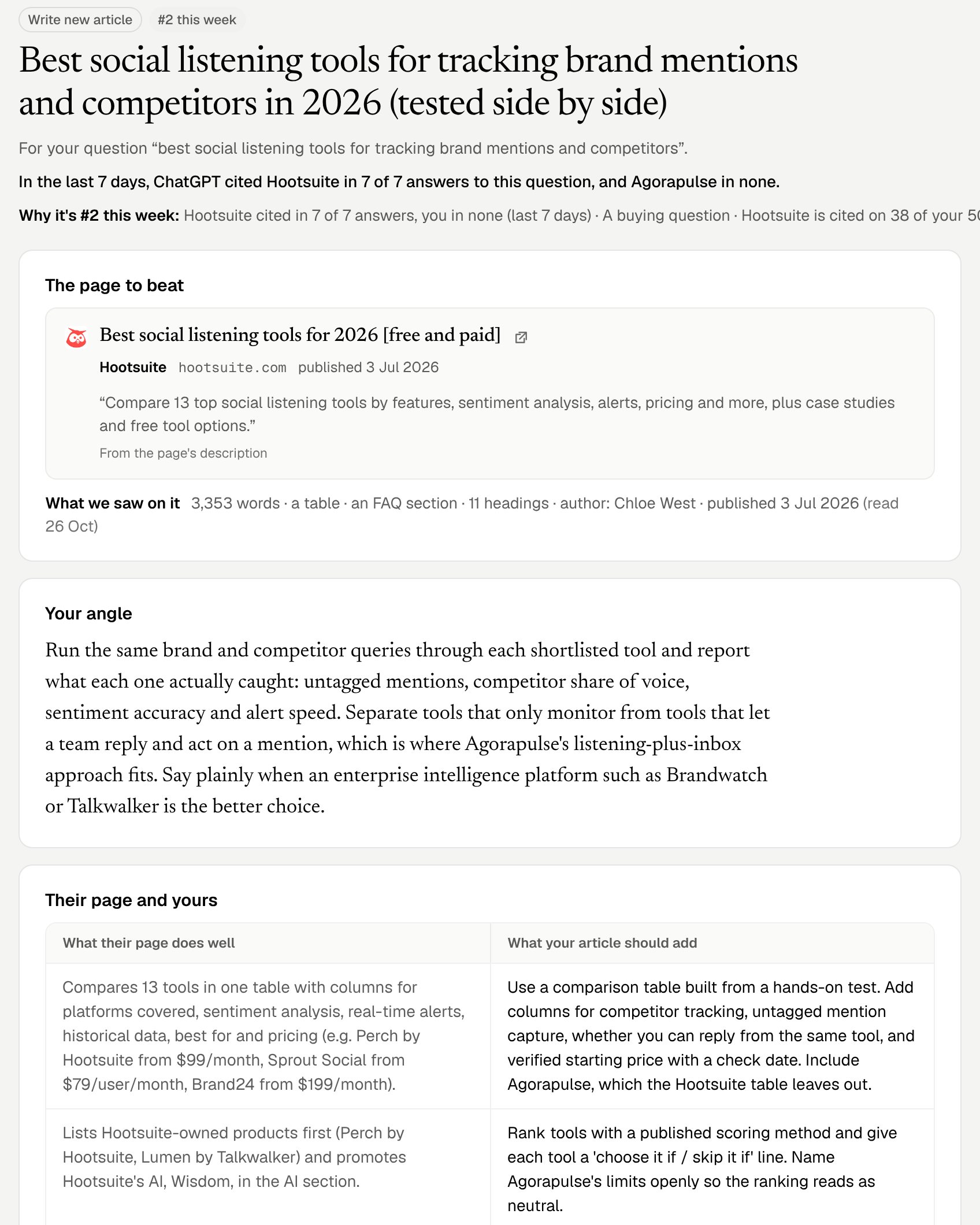
Cited.today asked the three questions through its ChatGPT collection, four times each with web search on, counted the brands each answer names and the pages it cites, read the cited pages and set each answer passage against the page it cites. Cited.today is a GEO (generative engine optimization) tool for SaaS teams: every day it asks ChatGPT the questions your buyers ask, shows which competitor pages ChatGPT cites instead of your site, and tells you which article to write. In the product, that reading becomes a brief: the competitor page ChatGPT cites on one question, how often in the last 7 days, the angle, and what your article should add.
What to publish if your SaaS sits in tool comparisons
- A starting price written as a sentence. "Product starts at $N/month" on your pricing page and on any comparison you publish. Semrush's line is the one three passages repeat.
- One sentence on what the product does, then a short bulleted list. Put it on your features page or a page written for AI assistants, as Peec AI and Otterly.AI do.
- A "best for" line you would sign. The answers label tools "Best budget option" or "Best for smaller SaaS teams"; state plainly who your product is best for rather than leaving that line to someone else.
- A dated, signed comparison of your category on your own blog, with yourself in it and a price for each tool. The Semrush article is the model in this sample. For a worked example on the same tools, see Semrush AI Toolkit vs Dedicated GEO Tools (opens in a new tab).
- A check of the third-party roundups that list you. Make sure your price, plan limits and verdict are current on pages like SaaSProven's; roundups like these were cited in place of the brand's own site in 6 of 15 passages.
To find which competitor pages are cited on your buyers' questions where you are not, Cited.today reads them and proposes up to 10 articles a week, each with a brief. The same pattern of prices, caps and verdicts showed up in cited CRM pages (opens in a new tab).